STRUCTIONAL ENGINEERING

OVERVIEW

TSA teams participating in the Structural Engineering event build a model of a structure on site with supplied materials to be destructively tested to determine design efficiency.

PURPOSE

The Structural Engineering event provides an opportunity for TSA teams to demonstrate their ability to design and construct a model structure from the provided material, within the allowed time after the size is selected. The model should reflect design and testing of models to improve the strength of the structure and construction ability of the team.

ELIGIBILITY

Entries are limited to one (1) team of two (2) members per chapter.

TIME LIMITS

  1. All participants in this event must arrive and be in place at the specified time and location.
  2. All work must be finished and checked in during the two (2) hours and thirty (30) minutes allowed for design and construction.
  3. The time begins when the dimensions of the structure are given.
  4. Participants with time conflicts must present a written explanation to the event coordinator of the conflict at least one (1) hour before the construction time printed in the conference schedule. Work must start during the time scheduled for the event.

PROCEDURE

  1. Participants report to the event area at the time and place stated in the conference program.
  2. Students are seated in teams of two by a monitor.
  3. Materials are distributed to each team and the construction procedure is explained.
  4. A random drawing determines the length specification.
  5. The length is recorded, the ending time is set, and then both are announced.
  6. Timing for the two hour and thirty minute event begins at the coordinator's signal. Participants may leave early, but must complete check-in as directed.
  7. All work stops at the coordinator's signal.
  8. Teams return all construction tools and excess supplies as directed.
  9. Structures are labeled with the team registration number.
  10. Structures are allowed to dry in a secure area until time for testing.
  11. Structures are checked for rules violations and checked on evaluation forms.
  12. Structures are weighed before testing
  13. Testing is completed by event evaluators and is open to all conference participants.
  14. Structures ate tested to determine failure weight.
  15. The efficiency rating of each structure is calculated and ranking is determined.
  16. Teams failing to comply with coordinator or monitors' directions will receive a twenty percent penalty.
  17. Videotaping is permitted during testing of structures test only.

REGULATIONS

  1. All work is done by the team in the area specified and within the time specified by the event evaluators.
  2. The material to be distributed to each team consists of twenty (20) feet of 1/8' x 1/8" balsa, a 3"x 5' note card, and glue. Only material provided during the event may be used.
  3. Tools provided for construction may not be used as part of the structure and must be removed before check-in. (See materials section below for specific list.)
  4. A sketch of the structure on the provided graph paper must be completed before cutting and/or construction may begin.
  5. The size of the structure selected by a random draw of the event coordinator is between 12 and 18 inches in an even number.
  6. Definitions the apply to the structure
    1. Lamination: Two (2) pieces of 1/8' x 1/8" balsa glued together surface to surface with the grain running parallel. Lamination of more than two pieces is not permitted.

CORRECT LAMINATION INCORRECT LAMINATION

 See PDF For pictures
 

    1. Failure weight: The greatest weight recorded during testing before failure of the structure.
    2. Failure to comply: If a structure fails to comply with any regulation, a penalty reduction of twenty (20) percent of the greatest weight held is applied to the teams' efficiency.
    3. Gusset: A panel or bracket attached to corners or intersections of truss components to add strength or stiffness. Note cards may be cut and used as gussets to strengthen the joints of truss structures. Note card gussets on trusses are to be no larger than the diameter of an American quarter dollar coin. They may not touch another note card gusset or overlap other trusses. They may not be sandwiched between two (2) laminated members.

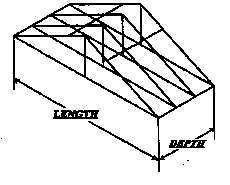
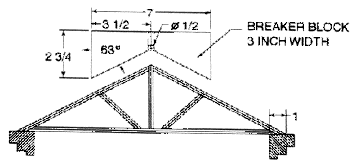
  1. The structure: A residential style roof truss with one (1) inch of rise for every two (2) inches of run.
  2. The length of the truss is the random number drawn.
  3. The height of the truss is one-fourth (1/4) of the length.
  4. The width of the structure is between 2-1/2 inches and 4 inches.
  5. No part of the truss may extend below the horizontal plane of the testing device.
  6. The peak of the truss is centered in the length of the truss.
  7. One (1) inch of each end rests on the tester.
  8. The truss must be a complete triangle. The breaker block accommodates a pitch of one (1) inch of rise for every two (2) inches of run.


FOR LTSA SPRING CONFERENCE 2001

THE ROOF TRUSS -

NOTE: the above rules are for the LTSA State Conference only Rules may vary at Nationals.

EVALUATION

  1. The structure is weighed before testing and the weight is recorded on the evaluation form.
  2. An increasing load is applied to the structure via the test block until the structure fails.
  3. The failure weight is recorded on the evaluation form.
  4. The efficiency is determined by the failure weight x 4.54 divided by the weight of the structure in grams.
  5. The efficiency is rounded off to three (3) decimal places and recorded on the evaluation form.
  6. The highest numeric efficiency is the winner. In case of a tie, the greatest weight held of the tied entries will be declared the winner.
  7. Structures that violate guidelines will receive a deduction of 20% of the greatest weight held for the first violation.
  8. Structures are not be tested if
    1. There are two rule violations.
    2. Structure cannot be placed on the tester.
    3. Testing hook cannot be placed in center of structure.
    4. Straight pins are left in structure.
    5. There is excess glue.


STRUCTURALENGINEERING

EVENT COORDINATOR INSTRUCTIONS

PERSONNEL

  1. Event coordinator
  2. Construction monitors
    1. A minimum of one (1) per twenty teams
    2. A timekeeper
  3. Evaluators to qualify structures after construction, three (3)
  4. Destructive test evaluators, five (5)
    1. One (1) to position the structure on the testing device
    2. One (I)to weigh the structure and record weight
    3. One (I)to record failure weight
    4. One (1) to bring the structure to testing location
    5. One (1) to remove and store the structure following testing

MATERIALS

All required tools and supplies are provided at the event. No substitutions or toots are permitted. The event coordinator before the beginning of check-in addresses any special needs.

  1. Coordinator's box, containing:
    1. Event guidelines, four (4) copies
    2. Official rating forms
    3. List of entries, with finalist report
    4. List of event evaluators/assistants
    5. Results envelope
  2. A sheet of poster board and marker to post the length and time.
  3. Construction tools per team to be used and returned after construction
    1. Modeling knife (1)
    2. Pin board 1' x 1' fiber board
    3. Cutting board I'x 1' hardboard
    4. Straight pins
    5. Clothes pins, spring style
  4. Supplies per team to be used to make the structure
    1. 20' of 1/8"x 1/8" balsa
    2. Colored adhesive aliphatic resin
    3. One (1) 3" x 5" note card
  5. Grid paper 1/4" x 1/4" grid on 11" x 17" paper for the sketch of the structure
  6. The testing equipment, selected by the event coordinator, provides a downward pull and records the peak force.
  7. Evaluation and recording equipment.
    1. Gram scale
    2. Tape measure or 2' rule
    3. Evaluation gauges
    4. Calculator or computer to perform calculations
    5. Evaluation for mass provided by the event coordinator, one (1) per entry
    6. One (1) American quarter dollar coin
  8. Site requirements
    1. Construction session
      1. Tables and chairs suitable for cutting and gluing
      2. A work area that is at least 2' X 3' for each team (suggested space is two teams per 6' x 2' or 8' x 2' table)
      3. Tables for equipment checkout and check-in
      4. Tables and chairs for evaluators
      5. Area securable for drying of entries and storage of supplies
    2. Testing session
      1. Tables for storage of structures
      2. Table for weighing
      3. Table for testing
      4. Table for recording
      5. Tables for storage of failed structures
      6. Chairs for spectators
      7. Barricade to separate testing area from spectators

PROCEDURE

  1. Upon arrival at the conference, report to the CRC room and check the contents of the coordinator's box. Review the event guidelines and check to see that enough evaluators/assistants have been scheduled.
  2. Inspect the area(s) in which the event is being held for appropriate set-up, including room size, chairs, tables, outlets, etc. Notify the event manager of any potential problems.
  3. One (1) hour before the event is scheduled to begin, meet with your evaluators/assistants to review time limits, procedures, regulations and all other details related to the event. If questions arise that cannot be answered, speak to the event manager before the event begins.
  4. Set-up check-in.
  5. Set-up material and supplies checkout.
  6. Plan the finished structure check-in, designate an area for structure storage, plan the materials check- in, and plan the participant checkout.
  7. Administer construction session procedure with participants.
    1. The construction session is not a spectator event. No one other than the participants is allowed in the construction site.
    2. Check-in may begin before the time printed in conference program and continues until all teams that have arrived on time have been checked-in and seated. Even if all teams are in place, the event will not start before the posted time.
    3. Both members of the team need to be present during check-in.
    4. No teams begin late unless the item in TIME LIMITS has been complied with.
    5. The recorder checks the registration number and records it on the entry list.
    6. Monitors check out supplies and materials.
    7. Monitors assign team construction locations.
    8. When all teams are seated and the scheduled event time has arrived, the event coordinator will select by random draw and announce the type of structure and the dimensions. Post the length on the poster board.
    9. The construction time of two (2) hours and thirty (30) minutes begins when the dimensions are announced. Post the completion time.
    10. Monitors confirm that the sketch is completed before each team begins construction.
    11. No additional balsa is provided during the event.
  8. Participant checkout:
    1. Participants must leave the assigned area clean.
    2. Participants' check-in excess supplies and construction tools as directed by the monitors.
    3. Participants place the structure in the storage area with the evaluator, form and sketch as directed by monitors. The structure must be marked with team number on the provided tag to insure proper evaluation and recording of results.
    4. Participants leave the construction site.
    5. Failure to comply with monitors during the event results in a twenty (20) percent reduction from the team's score.
    6. Monitors call "time" to end the construction session two (2) hours and thirty (30) minutes after the dimensions are announced. Teams that fail to comply are penalized twenty (20) percent.
    7. The structures are secured by the monitors and allowed to dry for a minimum of twelve (12) hours from the end of the construction session.
  9. Evaluation
    1. With the help of the event evaluators, check structures for compliance to specific regulations.
    2. Structures that are in compliance are tested without penalty.
    3. Noncompliance is noted on the evaluation form and the penalty is assessed.
    4. If a structure has two (2) noncompliance marks, it is not tested.
    5. Participants and advisors must be present to break structures that did not qualify for testing immediately following the testing session.
  10. Testing session procedure.
    1. The testing session is a spectator event. The structure storage area and evaluation areas are not open to the spectators.
    2. The testing device is set up and calibrated one (1) hour before the time to begin testing.
    3. Structures are brought by the monitors to the testing area.
    4. Each structure is weighed on a gram scale and the structure's weight is recorded on the evaluation form.
    5. The structure is destructively tested.
    6. The failure weight is recorded on the evaluation form.
    7. The structure is removed from the testing area by a monitor and stored with the drawing.
    8. The efficiency is figured and recorded on the evaluation form.
    9. Structures are not returned to participants after testing.
  11. The event coordinator submits the results and all related forms in the results envelope to the CRC room with the signatures of event evaluators having been applied to the evaluation forms.


STRUCTURAL ENGINEERING

2001 - 2002 OFFICIAL RATING FORM LEVEL I II

TEAM/SCHOOL ID#


EVALUATIVE CRITERIA

Check here when structure plan is received. (The structure plan has no point value. However, a plan must be submitted or the entry will not be considered for competition.)


Check here for proper structure size. (The structure must be within the specified size limits for this particular conference.)


Load failure


Weight of structure, in grams


Efficiency rating (See rules for proper formula. All rating should be accurate to three decimal places, e.g. 1.234)


SUBTOTAL (% of greatest efficiency)


Rules violation (if any) …………… minus 20 pts.


TOTAL ……………………………….. 100 pts.


Evaluator's comments/notes:


I certify these results to be true and accurate to the best of my knowledge.

Evaluator's signature ______________________________________